Scaling securely across Kenyan markets without rebuilding your IT stack
Every IT modernisation conversation in Kenya starts the same way: Someone says the legacy systems need to go, everyone nods, and then nothing happens because nobody can afford what it actually costs.
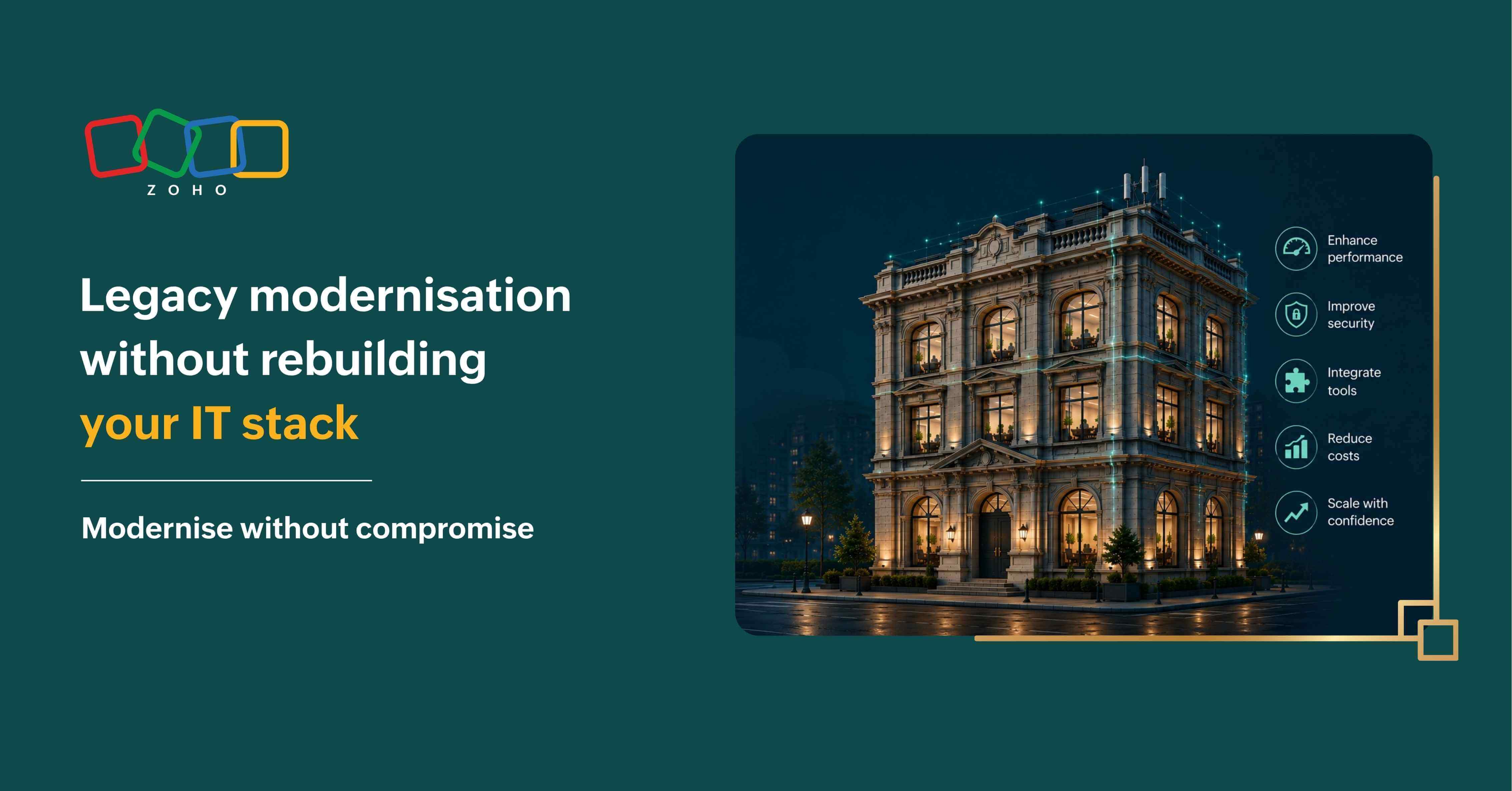
The systems don't need to go. They need company.
The assumption that modernisation means replacement has cost Kenyan organisations more time, money, and delayed decisions than almost any other belief in enterprise IT. It has kept good infrastructure sitting underutilised while the business waits for a transformation budget that never quite gets approved.
Scaling across Kenyan markets is hard enough without adding a full systems overhaul to the list. A business with headquarters in Nairobi and operations in Kisumu, Mombasa, or Eldoret is already managing inconsistent connectivity across locations, and a regulatory environment that continues to mature. As data governance expectations increase, organisations need systems that offer better visibility and control without disrupting day-to-day operations.
The question is not whether to modernise; it's how to do it without stopping the business while you do.
Why replacement fails
The instinct to start fresh is understandable. Legacy systems were built for a different scale, a different threat landscape, and a different version of the business. The appeal of a clean slate is real until you price it, timeline it, and account for everything that lives inside the system you're about to discard. That includes the institutional knowledge baked into workflows that aren't documented because they were built by people who understood the business at a specific moment in time and have long since moved on.
Most Kenyan enterprises can't absorb that disruption. A manufacturer running operations across three counties can't halt production for a 14-month ERP migration. A financial services firm cannot tell clients that transactions will be unreliable while the core system is replaced. Revenue doesn't pause for migrations, and customers don't wait for integrations to stabilise.
Enterprise ERP and CRM implementations regularly blow past their initial budgets and stretch long past their target go-live dates. It's what happens when a platform built for a completely different market, operating context, and organisational size meets the reality of deploying across Kenyan counties. Unanticipated customization needs, complex data migration, and extensive user training create a massive financial and timeline gap that rarely appears in the original vendor proposal.
"The strongest modernisation strategies don't discard what already works. They build on existing investments with stronger governance, better visibility, and the flexibility to scale as the business grows."
Veerakumar Natarajan, Regional Head - East Africa, Zoho
What building on top actually looks like
It starts with visibility, which sounds obvious until you look at how most legacy environments actually function: systems that nobody has fully mapped in years, applications running on infrastructure from a different cohort, and integrations that work until they stop—and when they stop, nobody is certain why, because the person who built them left years ago, and the documentation was never updated.
Before you can build on top of something, you need to know what you are building from. That means mapping what your systems do, what they connect to, what data they hold, who has access to it, and where the exposure sits. In a post-DPA environment, that audit is the foundation of every architectural decision that follows.
From there, the question becomes one of augmentation: where can modern tooling sit alongside legacy infrastructure without requiring a full cut over, where does cloud capability extend what exists rather than compete with it, and where does automation reduce the manual workarounds that have accumulated over years of making things work despite the system rather than because of it.
A phased approach doesn't carry the risk profile of a full replacement. It doesn't require the same level of external expertise to implement, and it doesn't ask the business to absorb disruption all at once. For most Kenyan organisations, that's the difference between a modernisation program that actually happens and one that stays on the roadmap for three consecutive years.
The governance gap nobody budgets for
This is the part that most IT modernisation conversations skip past too quickly, and it's also the part that causes the most damage when it goes wrong.
Scaling securely is as much a governance problem as a technical one. As headcount grows and operations expand into new counties or new markets, the question of who has access to what becomes harder to answer and more expensive to get wrong. In most Kenyan organisations scaling quickly, the offboarding process is manual, inconsistent, and often incomplete, which means former employees retain access to systems for weeks or months after departure.
Audit trails present the same problem. When something goes wrong—whether a data breach, a compliance query from the ODPC, or an internal fraud investigation—the first question is always who had access, when, and what they did with it. Organisations that can't answer quickly face more than operational exposure. The maximum statutory fine under the Data Protection Act is KES 5 million, but civil liability carries no ceiling, and reputational damage cannot be quantified at all. The ODPC issued its first penalty notice in 2022. By January 2026, it had issued 184 compensation orders in a single enforcement action.
Access management, user provisioning, offboarding workflows, and audit logging aren't glamorous problems, and none of them make it into board presentations the way digital transformation roadmaps do. But they are what determines whether scaling goes cleanly or creates a liability that surfaces eighteen months later at the worst possible time. Building these frameworks before scaling is almost always cheaper than retrofitting them after.
The cost of waiting
Every year an organisation delays modernisation is a year of compounding technical debt: more workarounds, more manual processes, and more distance between what the system can do and what the business needs it to do.
The organisations getting this right are making targeted improvements rather than running large transformation programs. They close the most critical security gaps first, add integration capability where it creates immediate operational value, and build governance frameworks that can grow with the business rather than be rebuilt every time it changes shape. They choose technology based on their actual operating context, not on what analyst firms recommend for enterprises in markets with different infrastructure, different talent availability, and different budget realities. They treat compliance as a forcing function that pushes them to do foundational work they should have done anyway.
The legacy systems don't need to go, but they can't stay exactly as they are either. The answer has always been in the middle. Most organisations just needed permission to start there.
The alternative that actually fits
Most conversations about legacy modernisation in Kenya end with a shortlist of enterprise platforms built for markets and organisations nothing like yours, priced accordingly, and supported by implementation partners whose timelines and fees are themselves a barrier to getting started.
Zoho is built to work alongside what you already have: a suite of over 60 products covering CRM, finance, HR, collaboration, and marketing, designed to integrate with existing infrastructure rather than compete with it, and priced in a way that makes the business case clear without requiring a two-year payback period to justify. The implementation doesn't require a dedicated team of external consultants. The platform scales as your business grows without requiring another procurement cycle every time headcount doubles, while built-in governance features such as access management, user provisioning, audit logging, and flexible data hosting options provide the visibility and control needed to support growth.
Modernisation doesn't have to be a project that takes over the business for eighteen months. It can start with one process, one integration, and one team and grow from there.
The systems don't need to go. They just need the right company.
FAQs
Do we need to replace our legacy systems to scale?
No. Most businesses can scale by integrating with what they already have instead of implementing a full system replacement.
Why is compliance important when expanding across countries?
As you grow, data access becomes harder to manage. Strong governance and clear audit trails help you avoid penalties and reduce risk.
What happens if we delay modernisation?
Delays increase manual work, security gaps, and technical debt, making scaling expensive over time.
Can Zoho work with our existing systems?
Yes. Zoho integrates with legacy tools, so you can modernise gradually instead of replacing everything at once.
Does Zoho help with data governance?
Yes. It includes role-based access control, audit logs, and user management features to support compliance.
Is Zoho suitable for growing service businesses?
Yes. It scales with your business and supports teams across multiple locations without complex implementation.