
Beyond the Friedman doctrine: Rethinking who a business truly serves
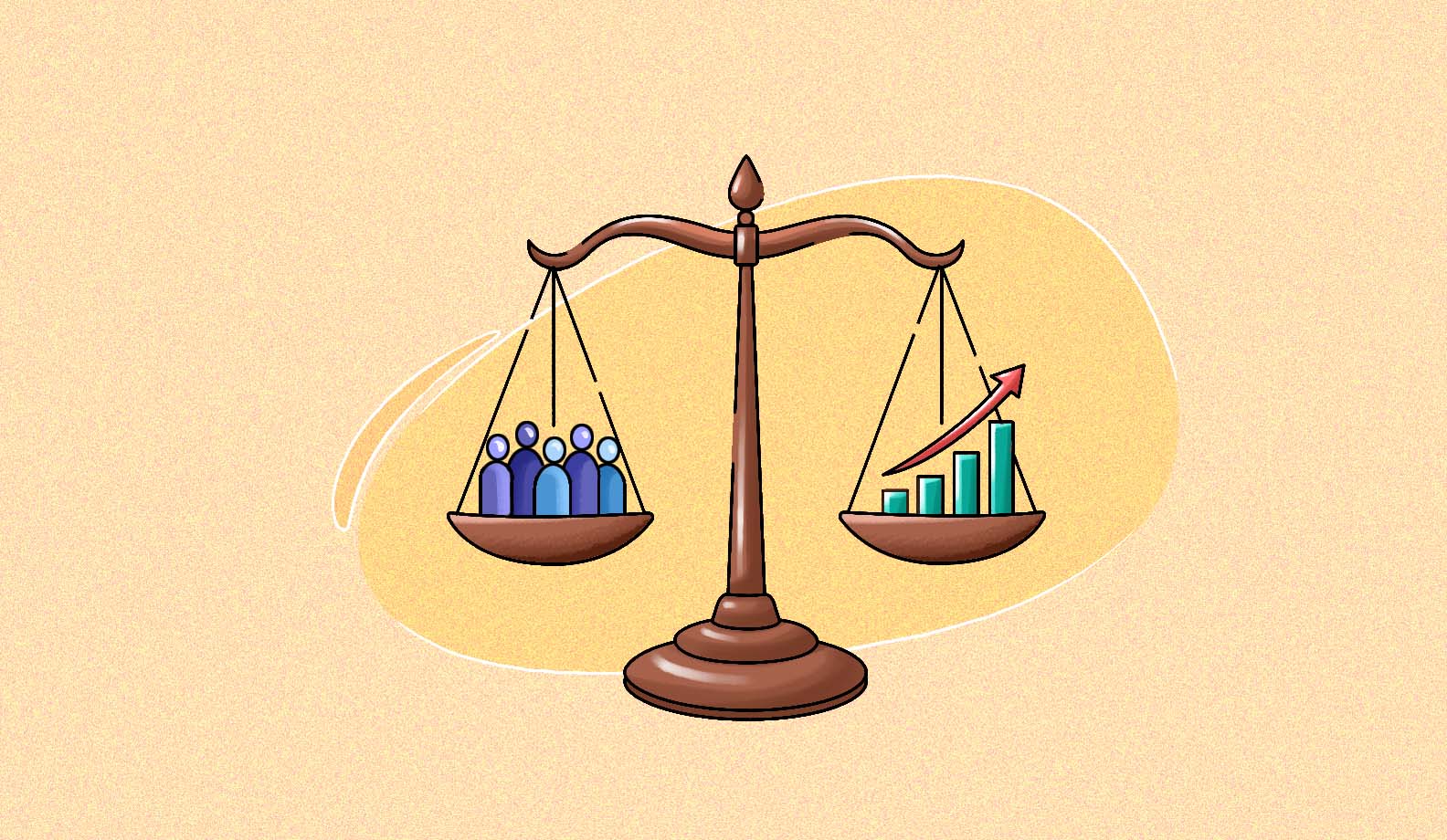
The purpose of a business, in other words, is not to make a profit, full stop. It is to make a profit so that the business can do something more or better. That “something” becomes the real justification for the business.
— Charles Handy in What's a Business For? (Harvard Business Review, 2002)
The Social Responsibility of Business Is to Increase Its Profits. This singularly assertive title of Milton Friedman's 1970 essay for The New York Times became the doctrine for businesses in the decades that followed.
As per this doctrine, businesses have no social responsibility—no obligation towards the employees or the community. Its only purpose is returning profit to shareholders, the true owners of a business. Every corporate executive appointed by shareholders must act only as "an agent serving the interests of his principal," he wrote.
"In an ideal free market resting on private property, no individual can coerce any other, all cooperation is voluntary, all parties to such cooperation benefit or they need not participate," Friedman asserted in the essay. "There are no 'social' values, no 'social' responsibilities, in any sense other than the shared values and responsibilities of individuals."
That's the route that large corporations went down eventually. With the financialization of the global economy through the 1980s and 1990s, Friedman's view took the shape of shareholder primacy: A company is not a community with obligations to its members but a collection of assets to be optimized for maximum shareholder return.
Corporations began tying executive pay to share price, engaging in stock buybacks, and normalizing mergers and acquisitions—all for the sake of boosting shareholder value. The results were unprecedented soaring of stock prices and market capitalizations to levels no prior generation imagined. In the 21st century, globalization carried the shareholder-first model across borders and into boardrooms worldwide, where it became the default operating mode for running a business. But soon enough, the cracks began to show.
Where the doctrine breaks down
After the 2008 global financial crisis, shareholder primacy was contested by even some of its fiercest advocates. Jack Welch, who in his tenure as CEO of GE went to the extent of laying off over 100,000 employees within 10 years to maximize shareholder value, went on to describe shareholder value as "the dumbest idea in the world" in 2009. "Shareholder value is a result, not a strategy," he concluded. "Your main constituencies are your employees, your customers and your products".
In another instance, the Business Roundtable, an association of chief executive officers of America’s leading companies, redefined the purpose of a corporation in 2019 to include delivering value to customers, investing in employees, dealing ethically with suppliers, and generating long-term value for shareholders. Nearly two decades earlier, they had declared in 1997 that "the principal objective of a business enterprise is to generate economic returns to its owners".
What made corporate leaders realize that prioritizing only the needs of the shareholders can be bad for business? A key problem with shareholder primacy is the gap between who holds power and who lives with the consequences. Shareholders can exit at any moment by selling their shares and moving on—but employees and customers, who are vital to any business, can't move on as quickly. Yet the doctrine concentrates decision-making power in the hands of those with the least exposure to the long-term fallout of short-term choices. The consequence is twofold:
Short-termism: Corporations are perennially under pressure to deliver returns in the short term for shareholders. So executives are solely focused on optimizing financial metrics and ignore investing in the foundations that long-term performance actually rests on—people, culture, innovation—that can't be captured on financial charts or justified to shareholders seeking immediate returns on their investment.
Zero-sum mindset: When shareholder return is the only obligation, every other stakeholder becomes either a tool or a cost. As Friedman pointed out in his essay, socially responsible acts could be done only at the cost of spending the money of the stockholders, customers, and employees. Consequently, businesses treat the network of relationships on which it depends—with employees, customers, communities, suppliers—as friction to be minimized to maximize returns.
Profit as means, not end
To further understand why the Friedman doctrine is untenable, let's see the definition of a business: A business is an organization that sells goods and services as per the needs and wants of its customers to make a profit.
While profit is clearly an important part of any business, it's not the end of the story. What a business does with the profit, as Charles Handy wrote, becomes the justification for that business. In other words, profit is a necessary condition for a business, not a sufficient one.
Since the goal is to meet the needs and wants of customers, it's evident that no business functions in isolation: They are part of the larger social fabric. For any business to stay in business and remain profitable in the long run, customers should want their products, employees should want to work for them, partners should want to associate with them, and communities should want their presence.
A business that depletes the trust of its employees, the loyalty of its customers, the confidence of its partners, and the goodwill of its communities can't withstand the slightest crisis, even though it may appear robust on the surface. Research shows that firms that invest in building trust among customers, employees and communities fare significantly better during periods of crisis than companies that don't. So moving away from shareholder primacy is well within the interest of businesses that intend to endure for decades and create a legacy.
What does moving away from shareholder primacy look like? By adopting a humanistic approach to business that shifts the focus from short-term value extraction to long-term value creation and views profit as the reward for valuing people. Broadly, this approach has three aspects:
Alignment of stakeholders: As opposed to shareholder primacy, stakeholder primacy involves taking into account the voices and wellbeing of shareholders, employees, customers and the community. It discards the zero-sum assumption of the Friedman doctrine that a stakeholder can be served only at the expense of others.
A broader purpose than profit: When a business frames a purpose that addresses a particular need (environmental, societal, or personal), it naturally focuses on building long-term resilience to fulfill the purpose. It also helps with stakeholder alignment, as it taps into the drive to be part of a larger cause.
High-trust culture: When a business prioritizes trust in every action, it results in a win-win situation for all stakeholders. High-trust organizations see better employee retention, stronger customer loyalty, lower procurement costs from suppliers, and greater support from the community—all of which lends a competitive advantage for the business.
This humanistic approach helps businesses counter the mechanistic one fostered by shareholder primacy, and puts into perspective the role that a business plays in the lives of all stakeholders.
At Zoho, we call this approach spiritual capitalism.
In Part 2, we'll look at how spiritual capitalism fundamentally redefines the nature of capital and why this shift ensures long-term prosperity. We’ll also take a deep dive on how Zoho brings these principles to life.


